Capability · Basement excavation
Going under an existing Sydney home, safely.
Under-house excavation, party-wall underpinning, contiguous piling, and the waterproofing detail that decides whether a basement is a usable room or a permanent damp problem.
What a basement project actually involves
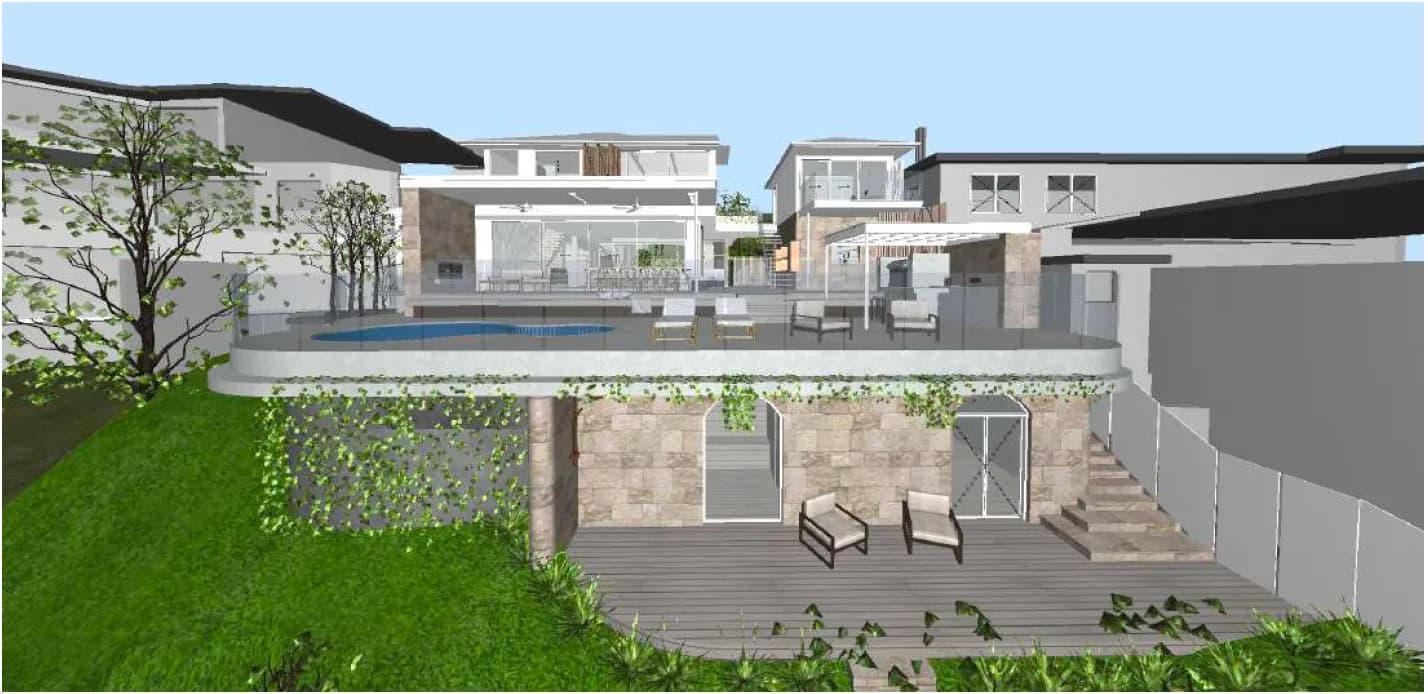
Excavating below an existing Sydney home is a structural-engineering project before it's a building project. The original footings need to be retained or underpinned. The party walls of any neighbour need to be protected — and in semi-detached and terrace contexts, that means independent geotechnical advice and usually a pre-condition dilapidation report served on the adjoining owners under the Dividing Fences Act and common-law nuisance principles. Excavation is staged so the ground above the dig is always supported. Waterproofing is detailed before the slab is poured, not after. Drainage is engineered to AS 3500 with a sump-and-pump strategy where gravity discharge isn't available. None of this is improvised on site.
Sydney ground conditions and what they mean for your project
Sydney sits on Hawkesbury sandstone in most of the inner ring (Eastern Suburbs, Lower North Shore, Inner West), Ashfield shale through parts of the Inner West and lower Northern Beaches, and alluvial fill closer to the harbour and rivers. Sandstone excavation is the cheap end — typically rock-bearing pads, dry digs, minimal dewatering — but rock-hammering hours are restricted by council noise regulations and neighbour-impact is high. Shale is mixed: faster to dig but weaker structurally, often needing more substantial retention. Alluvial and fill sites are the expensive end: dewatering required, perched water tables common, contiguous piling or sheet piling for retention, and structural slabs designed for hydrostatic uplift. The geotechnical report — bore log, water table depth, expansive-soil assessment — is the single most important pre-design document.
Underpinning, retention, and the staged excavation method
Underpinning original footings is rarely a single-step operation. Standard practice is the 'pit-and-pin' method: the new excavation is broken into 1–1.5m wide bays, each bay is excavated to the new basement depth one at a time (typically every third bay, then the alternating bays), the underpin mass concrete pour is placed, and the original footing is dry-packed onto the new underpin. Bays are sequenced so the building above is always supported by at least 70% of its original bearing area. For deeper excavations adjacent to neighbouring structures, contiguous piling (steel-cased CFA piles drilled to rock) is often used as a permanent retention wall. Soldier piles with timber lagging is the cheaper option for non-permanent retention but requires backfill against the new basement wall.
Why basement projects blow out
The single most expensive failure mode is discovering — mid-dig — that the geotechnical report didn't catch a rock shelf, a perched water table, or a service main running under the easement (Sydney Water trunk mains and Ausgrid HV cables are the usual surprises). The second is doing the structural retention on the cheap and ending up with differential settlement and cracking in the house above. The third is treating waterproofing as a finish rather than as a structural decision — a Type A tanked membrane system designed during the slab pour is fundamentally different from a Type C cavity-drain system designed after the fact, and choosing wrong locks you in for the life of the building. The fourth is neighbour disputes: unresolved party-wall, vibration, or noise complaints have stopped more Sydney basement excavations than ground conditions ever have.
Waterproofing strategies — Type A, B, and C
BS 8102 (the British standard most Sydney engineers reference) defines three approaches. Type A: barrier protection — a continuous waterproof membrane (sheet, liquid, or bentonite) applied to the structure, designed to keep water out entirely. Best when designed and installed during construction; difficult and expensive to retrofit. Type B: integrally protected structure — the concrete itself is the waterproof barrier (water-stop joints, hydrophilic seals, low-permeability mix). Used for basement walls where Type A access is constrained. Type C: drained protection — a cavity-drain system inside the structure that collects any water that does get through and discharges it to a sump and pump. Most resilient when groundwater is unpredictable; requires ongoing pump maintenance. Most Sydney basements end up as Type A with a Type C drained perimeter for redundancy.
How Varloch approaches basements
We treat the excavation, retention, and waterproofing as one structural sub-project — engineered, sequenced, and signed off — before any internal fit-out scope is finalised. The director walks the dig at every stage change. We use third-party dilapidation reporting on neighbouring properties before any excavation starts. Neighbour relations are managed actively because basement excavations in dense Sydney suburbs upset neighbours faster than anything else, and we'd rather have the awkward conversation about working hours and dust before the rock-hammer arrives than during the first complaint to council. And the waterproofing detail is signed off by an independent waterproofing consultant on every project — not left to the membrane installer to interpret the architect's drawings.
Frequently asked
Do I need DA approval for a basement?
Almost always, yes. Most Sydney councils treat a basement as either a major works DA or, in some LGAs, as a sub-floor addition needing specific consent. Talk to a planning consultant or architect before assuming complying development applies — and bear in mind any basement that adds GFA, alters the building footprint, or excavates near a heritage item will be a full DA process.
Can you excavate under a terrace with neighbours on both sides?
Yes, with proper engineering. The party walls need to be either retained with engineered support or independently underpinned. Pre-condition dilapidation reports for both adjoining properties are standard before work begins. Construction insurance needs to specifically cover adjoining-property damage — the standard CW policy is not enough on a basement excavation under a terrace.
How deep can you go?
Practically, 2.4–3.2m head height is common in Sydney sandstone country and cost-effective. Deeper is technically possible but quickly drives geotechnical, retention, and waterproofing costs up steeply, and may require pumped drainage if the water table is above the slab. Beyond about 4m depth, the project economics usually need a hard re-think.
Will my house crack?
Minor settlement cracking is possible on any underpinning project. With good engineering, monitoring, and staged excavation, it's manageable, cosmetic, and rectifiable as part of the contract. With poor engineering, it's structural and expensive. We use prism monitoring on heritage and adjacent structures during excavation to catch movement before it becomes visible damage.
Can I have a bathroom or wet area in the basement?
Yes — most Sydney basement projects include at least a powder room and often a full bathroom or laundry. Sewer discharge from below the public sewer level requires either a gravity connection (rare) or a pumped sewage ejector system (Saniflo, Grundfos Sololift). Both work; the pumped system is the typical solution.
How long does a basement excavation add to the program?
Typically 3–6 months on the construction program before above-ground works can resume. Excavation itself is usually 6–10 weeks; underpinning sequencing adds 4–8 weeks; structural slab + waterproofing adds another 4–6 weeks. The basement structure has to be water-tight before backfill or upper-level loads.
What about radon and ventilation in a Sydney basement?
Radon is generally a low risk in Sydney compared to UK or US sites, but mechanical ventilation is required by the BCA for any habitable basement room, and we typically design 3–5 air changes per hour for living spaces. Wine cellars and storage are separately ventilated with humidity control.
Working on something in this space?
Tell us about your site.
We do an initial conversation either over the phone or on site — your call. No deck, no sales pitch. Just a look at what you’re trying to do and an honest read on whether we’re the right team for it.
Builder of the Year
Australian Business Champions Awards
NSW · Residential construction