Building a basement on a tight inner-Sydney site usually involves a sentence that makes some clients nervous: "we'll need to underpin next door's footings to do this." It's not a sentence we use lightly. But on heritage streets and corner blocks where the original footings sit half a metre from the boundary, it's often the only way the basement actually happens.
This article is a short, plain-language explanation of how we sequence that work — and why the sequencing matters more than almost anything else on the job.
What underpinning actually is
Underpinning is the process of extending an existing footing — yours or your neighbour's — downward, in stages, so that the bottom of the footing sits below the level you're about to excavate to.
If you don't underpin, and you dig down past the bottom of the existing footing, the footing has nothing to bear on. It loses lateral support. It moves. The wall above moves with it. Cracks open up. In the worst cases, the wall fails.
The job of underpinning is to give that footing a new bearing surface, deeper than your excavation, so the wall above doesn't notice that you've dug a basement next to it.
Why sequencing matters
The temptation, when you're a builder under program pressure, is to underpin in long continuous strips so you can move through the work fast. That's how walls fail.
Underpinning is done in alternating short pins — typically 1.0 to 1.5 m wide, with the same length of un-touched footing between them. We pour and cure each pin, wait for it to gain enough strength to carry load, and only then come back for the next set.
A worked example, simplified: on a 12 m boundary wall, we might break the underpinning into eight pins. We'd dig and pour pins 1, 3, 5, 7 first. Wait for them to cure. Come back and do pins 2, 4, 6, 8. At every moment, half the original footing is still untouched and carrying its share of the wall above. The wall never sits unsupported on a long unbraced length.
Skipping that sequence — digging two adjacent pins, or leaving a longer gap unsupported — is what causes the cracks that show up in news stories about excavations gone wrong.
What we coordinate around the underpinning
Underpinning is the spine of the early-works program on a basement job. Around it we sequence:
- Geotechnical involvement. A geotechnical engineer specs the pin size, depth, and concrete strength based on the actual ground conditions. This isn't generic.
- Structural sign-off on the underpinning sequence and any temporary propping. Every site is different; the engineer is on the design every time.
- Neighbour relations. The owners of the property we're underpinning are a real stakeholder in the project. They get a written program. They're told before each phase. We carry the public liability cover that protects them while we work, and we provide condition reports of their property before and after.
- Excavation. Bulk excavation can only proceed once the relevant pins for that section are cured and verified. The dig order follows the underpin order.
- Capping beam. On most of these jobs, once the underpins are in place we tie them together with a capping beam — a continuous reinforced concrete beam along the top — so the underpins act as a stable line, not a series of disconnected blocks.
- Shoring. Where the basement face is tall enough or the soil is loose enough, we install temporary shoring (soldier piles, anchors, or shotcrete) before we bulk-excavate the centre of the site. Underpinning protects the boundary; shoring protects the rest.
What this looks like for the client
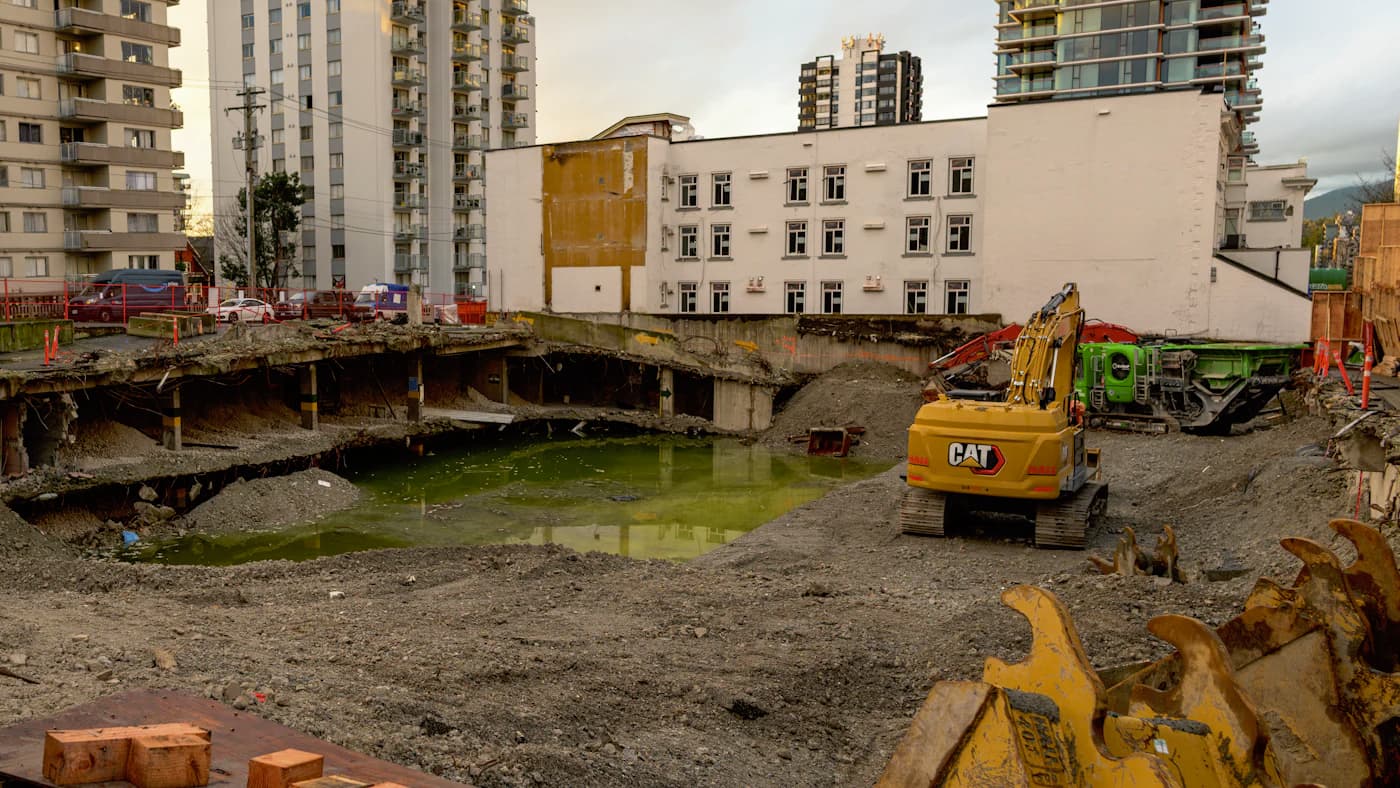
A basement excavation on a tight Sydney site is not a fast job. The early-works program — underpinning, capping beam, shoring, bulk excavation — can run six to twelve weeks before any building work above ground starts. The temptation is to compress that. The right answer is almost always to let it run at the engineer's pace.
The reason we work on these projects, and the reason we run them slowly at the start, is that you only get one chance to do the early works correctly. Everything above is just construction. Underneath is the part where you can't go back and fix mistakes without starting again.