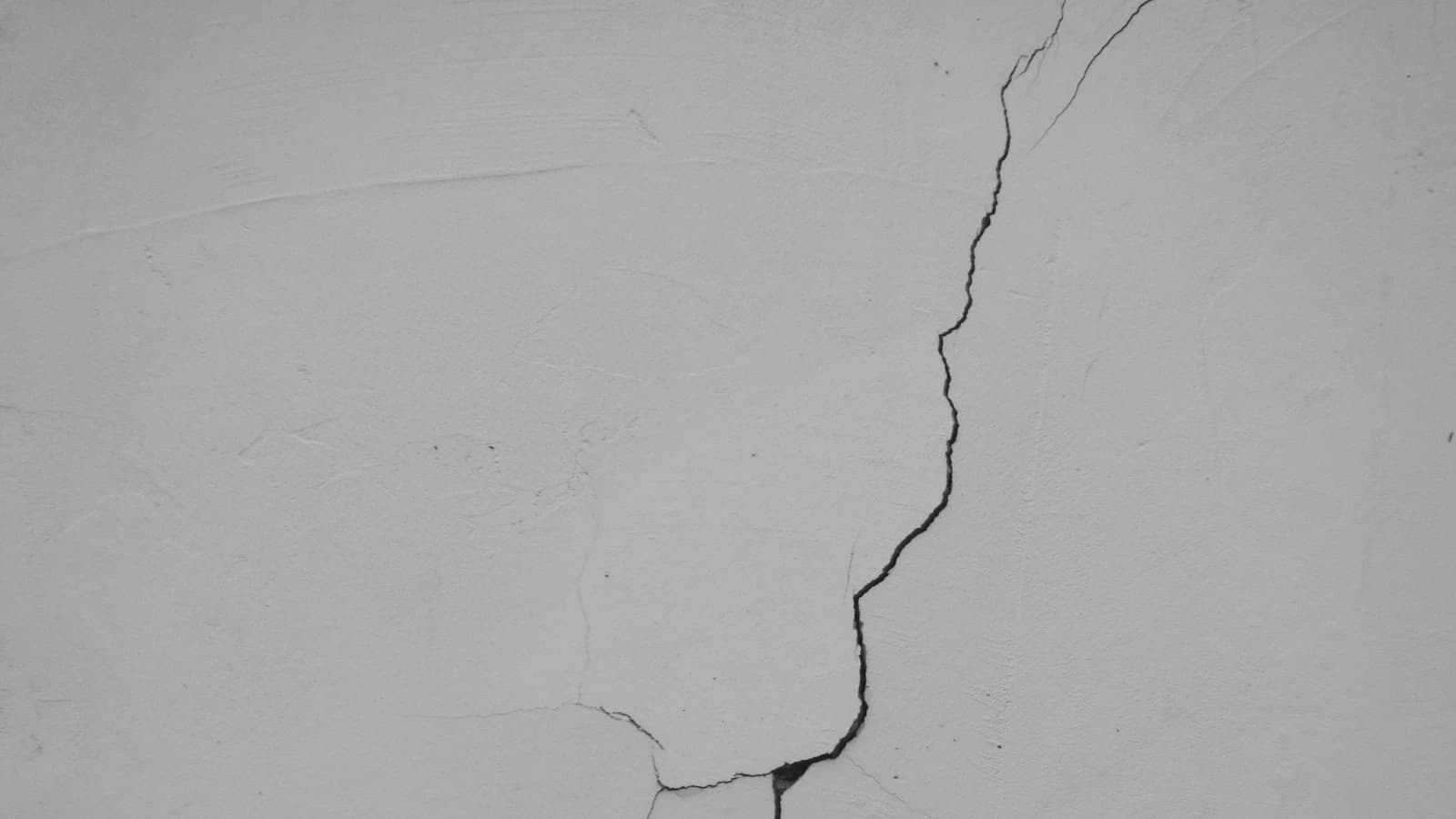
You've moved in. The keys are yours. And now — somewhere between week three and week eight — a small crack appears above a doorway, or a hairline runs down a plaster wall, or a skirting board pulls away from the corner by half a millimetre.
This is normal. Almost every new house does it. It's worth understanding why.
What's actually happening
When we hand a house over, the building is full of construction moisture. Concrete is still curing. Timber framing absorbed water through the build. Plaster, render, mortar — all of them carry water on day one.
Once you start living in the house — heating it, cooling it, drying clothes inside, breathing in it — that moisture leaves. As it leaves, the materials shrink slightly. They don't shrink uniformly: timber moves more than brick, plaster more than timber, the warmer corners faster than the cooler ones. The result is small, cosmetic surface cracks where two materials meet, or where a long run of plaster needs a place to release a little stress.
These cracks are not a sign that anything is structurally wrong. They are the building stabilising.
What to do about them
Don't panic. Don't get out the gap filler the next morning.
Wait. The first eight to twelve weeks are when most of this movement happens. After that, most of these cracks become stable and many close up on their own as humidity changes through the seasons.
When the movement settles, a fresh coat of paint and a hairline of flexible filler in the right places handles the cosmetic side. If you're a Varloch client, this is one of the things we cover in the post-handover walk-through.
What's not normal
Most cracks are cosmetic. A few aren't. The ones to call us about, immediately:
- A crack wider than 2 mm.
- A crack that grows visibly week to week.
- A crack that runs diagonally across a corner of a room or a door reveal.
- A crack accompanied by a door or window that suddenly won't close.
- Any crack accompanied by a damp patch.
Those are the ones that may not be the house drying out. They could be drainage, footings, settlement under a slab, or moisture getting somewhere it shouldn't. We want to look at those.
A small ask
In the first months: let the house breathe. Don't run heating hard the day you move in. Open windows in dry weather. Run extractor fans when you cook and shower. The faster the house can lose its construction moisture in a controlled way, the less material movement you'll see — and the fewer cosmetic cracks will appear.
If you're unsure about a crack: photograph it, note the date, and send it through. We'd rather look at ten things that turn out to be nothing than miss one that wasn't.